
Q&A: Might a UVA Discovery Reverse Multiple Sclerosis?
Nov. 4, 2026
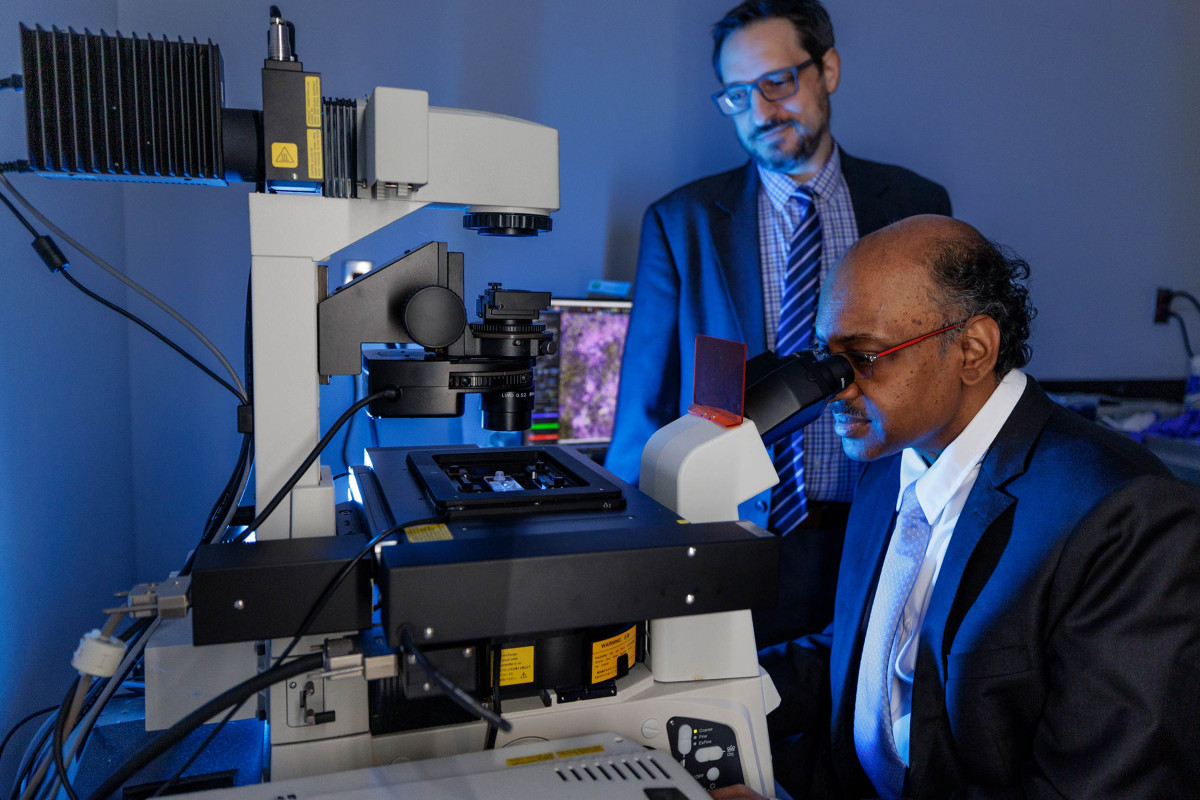
A drug developed by Dr. Jayakrishna Ambati of UVA’s School of Medicine has, in some cases, reversed the course of the disease – lost eyesight restored, lost movement regained. Ambati’s breakthrough is an example of how UVA is pursuing meaningful research by fostering innovation, investing in world-class faculty and facilities, and advancing discoveries that improve lives and address society’s most pressing challenges.
The early findings are so promising that government agencies have hailed it as “groundbreaking research,” and the director of the National Institutes of Health posted a video about UVA’s work.
UVA Today caught up with Ambati to talk about the promise of this new drug.
Q. Briefly, what is multiple sclerosis, or MS?
A. Multiple sclerosis is an autoimmune disease in which the immune system attacks the brain, spinal cord and optic nerves. The immune system primarily attacks myelin, which is the insulation that wraps nerve fibers and enables them to carry electrical signals rapidly. When myelin and the nerve fibers are damaged, people can lose vision, strength, sensation and coordination.
MS is the most common disabling neurological disease of young adults, affecting nearly a million Americans. Most people first have attacks followed by partial recovery, but many later develop steadily worsening disability.
Q. How has MS been treated, and what are the limitations of those treatments?
A. There are more than 20 FDA-approved drugs that modify the course of MS. They can reduce new inflammatory attacks and reduce the rate of relapses. However, they are designed to prevent the next attack, not to repair damage that’s already occurred. So, function that’s been lost generally doesn’t return.
They also have a limited effect on the slow, progressive phase of the disease. Also, because these drugs broadly suppress the immune system, some of them can result in serious infections.
Q. In lay terms, how is the drug you developed, Kamuvudine, or K-9, different? What promise does it have that other drugs lack?
A. K-9 works differently from existing MS drugs. It blocks very specific immune pathways called inflammasomes, which are a sort of molecular detonator inside cells that kill nerve cells and their surrounding myelin sheath. In mice with an MS-like disease, we administered K-9 only after paralysis and vision loss had already occurred. Remarkably, the mice recovered movement and vision, their nerve fibers and myelin were preserved, and a blood marker of nerve damage stopped rising.
Mice given a standard MS drug, however, did not recover lost function. The ability of K-9 to restore lost function, not just prevent new attacks, is what’s strikingly different from current MS drugs. K-9 is also an oral medication that would be more convenient than many existing drugs.
Q. It is early in the process, but how are you feeling about this discovery? Is it a breakthrough? Is it a reason for hope for those living with MS?
A. I am excited and encouraged, but cautious. Seeing mice recover movement and vision after the disease had set in was remarkable, and no other treatment we tested came close. Human data point in the same direction: In insurance records from more than 3 million people, those taking NRTIs, the HIV drugs K-9 is derived from, were 41% less likely to develop MS, and those with MS had 36% fewer relapses per year. (NRTIs are antiviral medications.)
Still, these are mouse results and associative human data. Randomized, controlled clinical trials in patients will tell us K-9’s true breakthrough potential. It is definitely a reason for optimism and hope.
Q. What are the next steps?
A. The next step is to conduct a randomized, controlled clinical trial in people with MS. K-9 has already been given to people in clinical trials for diabetic macular edema and thyroid eye disease, providing us human safety experience to build on. An MS trial would test whether K-9 lowers neurofilament light chain, the blood marker of nerve damage that was reduced in our mice, and whether it slows or reverses disability. We are seeking funding and partners for such a trial. We also plan to study K-9 in ALS, Alzheimer’s disease and Parkinson’s disease, where the inflammasome is also a key driver.
You can read more about UVA’s scientific breakthroughs and health advances at the Office of the Vice President for Research’s news page.